Kenyon’s travel-embedded courses intermix ongoing and deep engagement in course curriculum with site-specific activities that enhance deep and reflective learning. The on-site component furthers curricular goals by allowing you to contextualize the topics of the course while gaining critical site-specific experience. Thanks to our generous donors, these high impact experiences are fully funded so you can participate without financial worry.
Our travel-embedded courses traditionally take advantage of spring break. This traditional structure includes seven weeks of academic work before and after the travel component that is specifically designed to a) prepare you to maximize your on-site learning and, b) upon return, enable you to continue to deepen your understanding of the course concepts and recognize how these concepts are activated in situ.
Depending on course learning goals and objectives, these courses may enable you to:
-
Address themes, theories, or practices integral to the course and explore it first-hand through conversation, observation, analysis, etc.
-
Observe, analyze, and/or explicate the material or phenomenon explored in class.
-
Recognize/witness and probe how theory articulated in a text is typically less complex than its practical counterpart. That is, learn how cultural norms, politics, education, economics, religion, local environment, etc., complicate theory.
-
Enhance problem solving ability by expanding your understanding of this complex and nuanced world and seeing, first hand, why interdisciplinary approaches are often needed to solve important world problems.
-
Deepen the cultural and linguistic context of what you are learning.
Experiencing the concepts we studied in class firsthand allowed us to forge a deeper connection with the material and gain a greater understanding of ourselves.

Recent Travel Embedded Courses
To deepen understanding of class concepts and connect them to real world insights, the class travel component takes advantage of elements such as site-specific natural and/or built environments, local expertise, community interactions, and student-guided learning that was prepped prior to the travel component.
The following class descriptions illustrate why $$percent $$ of students in the classes stated that travel component $$ extremely impacted$$$ the learning process of the class
Course description and learning outcomes:
This course explores the intersection of science, culture, and politics in the Galapagos Islands. The Galapagos Islands are scientific icons: since Charles Darwin developed his theory of evolution, the islands have continued to serve as a natural laboratory for ecological and evolutionary study. Additionally, the islands have uniquely complex political and cultural stories that highlight the competing interests of people and the rest of the natural world. Students in this course will examine the conflicting interests of tourism, fishing, farming, cultural identity, wealth, science, and society as they all collide in this UNESCO World
Upon completion of this course students will be able to:
● Identify, explain, and analyze LOCAL Galapagos themes and relate them to global themes, processes, and systems:
○ Students will be able to identify and describe different examples of how Galapagos’ unique history and culture contributes to its role as a conservation icon.
● Critically examine the relationship between the often-competing interests of people and nature:
○ Using specific examples from the course and the immersion experience, students will be able to articulate the complex relationship between humans and nature in Galapagos.
● Demonstrate knowledge and skills essential for understanding complex interactions between humans and nature by:
○ Learning the natural history of Galapagos organisms.
○ Examining scientific ideas (especially evolution) and their relationship to themes in conservation biology, such as invasive species, biocontrol, impacts of tourism, and habitat degradation.
Course description and learning outcomes:
This course introduces students to the ancient Greek world from the Bronze Age through the Hellenistic period, with an archaeological examination of its houses, temples, tombs, sculptures, pottery, inscriptions, coins, and other everyday objects. The course and its trip to Greece provide the opportunity to:
Explore the daily life of the ancient Greeks in both cities and the countryside surrounded by the very geography in which they dwelled, including the island of Aegina
Examine museum artifacts close up and understand their context among related artifacts and how they demonstrate the cultural intermingling of the Greek world
Walk around an archaeological site to understand its scale and organization in the ancient world, as well as the modern techniques used to glean information about the people who built and inhabited the site (plus go inside the Parthenon!)
Hold an ancient object and learn about the scientific processes of conservation in a lab
Consider the intersection of ancient and modern life in Greece, including issues of cultural heritage and repatriation
By the end of this introductory-level course, students should be able to:
Understand the task of an archaeologist and learn how to “read” the material remains of the ancient Greek world.
Identify and describe major art and architectural monuments, artifacts, building materials and artistic and architectural styles from the Greek world.
Recognize and consider the significance of specific Greek monuments in light of themes, concepts and principles appropriate to ancient art as well as their relationship to modern cultural history.
Use Greek artifacts and architecture as evidence for making arguments and expressing insights about their role in the multicultural world of antiquity.
Discuss in class and analyze in writing scholarly arguments about Greek art and architecture.
Consider ethical and professional issues regarding conservation, preservation, private and public collections and museum display.
Art, Money, Museums (ARHS 291) explores the complex history of art, money, and museums from the fifteenth century to the present. It is taught by Professor Katherine Calvin, Assistant Professor of Art History at Kenyon College. The 18 first- and second-year students in this course consider the social and economic roles of artists; the international development of art auctions and fairs; and art collecting as a form of financial and cultural capital. These topics are examined critically in relation to debates, both past and present, about the ethics and legality of collecting and displaying art, artifacts, and, in some cases, people in museums, exhibitions, and art fairs. Considering the history of museums and the art market involves confronting the exploitative and extractive processes by which these institutions came into existence in early modernity and in which they continue to operate today.
Art, Money, Museums will include a spring break travel component, specifically eight days of on-site visits in the Netherlands and Belgium to museums, galleries, artist studios, and auction houses in March 2026. The travel component of the course will be co-directed by Daisy Desrosiers, David and Francie Horvitz Family Foundation Director and Chief Curator at The Gund at Kenyon College. The origins of the international art market developed in the early modern Low Countries. It was here, first in fifteenth- and sixteenth-century Bruges, Ghent, and Antwerp and later in seventeenth-century Amsterdam and The Hague, where artists first made works on speculation, rather than commission, at scale for open markets. Much of the wealth that underwrote this new art market stemmed from contemporaneous financial innovations like limited-liability companies, stock exchanges, and insurance – all entities that still undergird today’s capital markets worldwide. Dutch and Belgian museums thus offer a unique window onto the Low Countries’ earliest markets, as well as their connections to the development of capitalism, imperialism, and global trade.
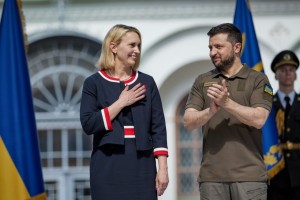
Quest for Justice
Ambassador Bridget Brink ’91 relies on lessons she first learned at Kenyon to navigate the literal and figurative minefields of Russia’s war in Ukraine.