
Environmental Studies at Kenyon Takes the Liberal Arts Approach and Magnifies It
We’re comfortable in waders—and in boardrooms. Our professors win research awards, take pride in mentoring students, and sometimes ski to work. We see the world in a microscopic particle of dust. We design solar arrays on campus and work with communities on distant continents.
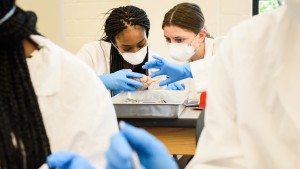
A Concentric Circle of Mentorship and Advising
At Kenyon, mentorship' isn't a buzzword; it’s a four-year relationship. When our professors write your recommendation, they aren't reading a resume—they are describing a student they’ve mentored in the lab, in the office, in the coffee shop and who they have taught for years. Advising is not left to a single point of contact—it is intentionally built as a layered, interconnected system of faculty and staff support. Together, this structure forms a true “concentric circle” of advising—where faculty mentorship, committee guidance and professional career support overlap.
-


A Major Advisor
Every student is paired with a faculty advisor in their major, a relationship designed to grow. These advisors come to know students deeply—their academic strengths, goals and personal trajectories—and serve as the foundation of long-term mentorship. This continues a practice Kenyon was first to establish in higher education: prioritizing a model of sustained, faculty-driven advising.
-
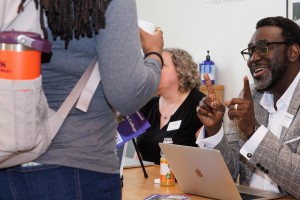
Health Professions Advising Committee
Surrounding this core relationship is the Health Professions Advising Committee (HPAC), a dedicated group of faculty who work collectively to guide pre-health students and alumni and bring comprehensive advising throughout the entire pre-health journey—from course selection to application strategy.
-
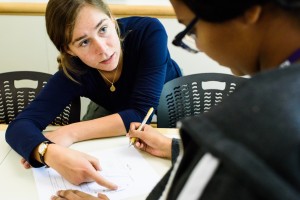
A Dedicated, Pre-Health Career Advisor
In parallel, students work with a dedicated pre-health career advisor in the Career Development Office, Sara Stasko. This role complements faculty advising by focusing on clinical experiences, internships and long-term professional planning.
"We can challenge students and we can push them, but that doesn't mean we are trying to push one ahead of another. We want everyone to succeed in the face of a rigorous experience. The true mark of an educator is raising the performance of everyone, not just the already high-performing individuals."
Rigor without Rivalry
While our curriculum is intentionally demanding, it’s grounded in collaboration. From upperclass mentors to faculty invested in your growth, to a community of 300+ peers committed to your success, you’ll find a network that supports you at every step. At Kenyon, you’re challenged—but never alone. What we consistently hear from graduates in medical and other allied health professional schools is that while the volume of material is new, the rigor is not.

Nobody navigates the first year alone. Through the K-STEM Mentor Program, upperclass students who have "been there" help new students balance social life, science prerequisites, and the transition to college.
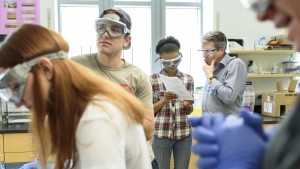
Mentorship without barriers. At Kenyon, professors aren't just lecturers; they are advisors and mentors who prioritize your individual growth. Our faculty believe their success is measured by the success of the entire cohort.
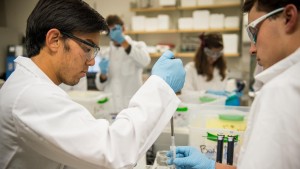
Research as a team sport. Programs like Cascade allow students to conduct independent experiments early.
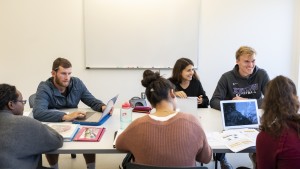
Success is a collective achievement. We’ve designed our spaces to mirror our philosophy: medicine is interdisciplinary, and the best solutions come from diverse perspectives working toward a common goal.
Support that’s always accessible. Whether it’s a question about class or a hurdle in your MCAT prep, our "open-door" culture ensures you never have to work for the answers in isolation.
Open, Early Access to Funded Research
At Kenyon, we don't just offer research; we engineer early entry into it. By removing the traditional barriers—experience, seniority and financial burden—we ensure that our students have early and frequent access to research opportunities and funding. Here, you don’t have to wait for your senior year to contribute; we provide the funding and mentorship to get you into the lab as early as your first summer on campus, and sometimes even earlier than that.
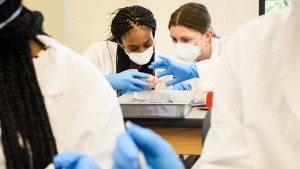
The Kenyon Clinical & Professional Ecosystem
At Kenyon, you don’t just observe medicine; you participate in it. Without medical residents to compete with, you are at the heart of the healthcare ecosystem—with opportunties to shadow in the ER and other medical spaces, coach patients and building a professional network through our loyal alumni and community partners.
-

KC Meds: Designed by students, for students
This core student organization is the primary hub for pre-medical, dental, and veterinary students. Beyond peer support, KC Meds facilitates interactions with local physicians, organizes clinical field trips, and sponsors social events that build a collaborative pre-health community.
-
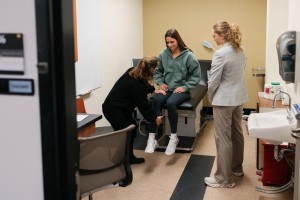
Knox Community Hospital Partnership
Formal shadowing at KCH allows students to experience diverse healthcare roles firsthand. These placements are designed to help students identify their specific interests within medicine and understand the practical skills required for various clinical occupations.
-
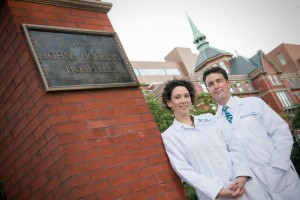
Alumni Physicians Network
Kenyon's pre-health students benefit from a deep network of alumni who are current medical students and practicing physicians. Through the Kenyon Network, students can connect with graduates for career advice and mentorship, while KC Meds frequently hosts networking sessions.
-
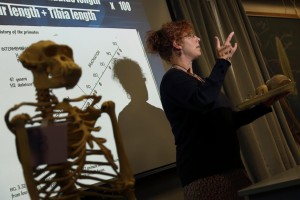
Health Service and Biomedical Analysis
This seminar-based course is a hallmark of the Kenyon pre-med experience. Students volunteer weekly for a minimum of four hours at Knox Community Hospital or with local emergency services while simultaneously critiquing biomedical research.
"I shadowed a pediatrician at KCH for a year. I worked as a patient care tech at a local hospital. I shadowed in a private practice and even with a pediatric psychiatrist. I’ve seen dermatology, primary care and specialized medicine firsthand, which helped me understand where I might fit best in medicine."

Where Science Meets Story
Kenyon's well earned reputation as a writer's college means that you learn to tell the story behind the science. When you sit down for a med school interview or write your personal statement, you have a level of critical thinking and narrative skill that sets you apart from thousands of biology majors nationwide.
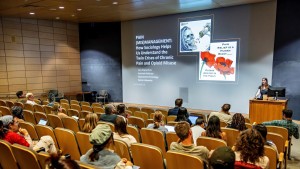
"I took an English course — literature, medicine and culture, taught by Dr. Lau. It's all about the medical humanities and how we narrativize medicine, how we tell stories about it, how we talk about medicine, how we talk about disability, how we talk about health, how we talk about disease, and how we write about those. We read so many patient accounts of 'this is what my illness means to me, or this is how I understand it, or this is what the doctors were like' — that really gave insight into their experience in a way that I don't think is achievable outside of the humanities. It's definitely changed the way that I write. I'm a lot more conscious of my word choice and the metaphors that I use and why I'm using them." —Sam Connors '26

"I think we'd be remiss if we didn't talk about the strength of writing and communication that Kenyon gives students on the way to becoming healthcare providers. When we look at a test like the MCAT, an entire fourth of that test is critical analysis and reasoning. Our students thrive on that section. The skillset that is needed to really achieve a solid score on that section of the MCAT is built into how we approach across discipline our subjects here at Kenyon. But on the other side of it, it's that patient practice, that human interaction and how they reflect and articulate that as they apply to programs that are very competitive." -Sara Stasko, Senior Associate Director of Pre-Health Advising

"A liberal arts education will help prepare you in communicative skills and writing skills. And that's a major part of the med school application process — being able to write on your experiences. You could be an amazing researcher and have groundbreaking findings, but your findings are as good as nothing if you're not able to articulate them and write them in a comprehensive piece that other people are able to read and benefit from." Seryne Rafique '26